.png)
In an industry driven by logistics, timelines, and production schedules, it’s easy to believe event strategy is about execution alone.
It’s not.
At its core, event strategy is about people.
I learned that firsthand while working for a Fortune 10 company, planning a large-scale annual event off the side of my desk. What began as an added responsibility quickly became something more. Each year, I became fascinated by how small shifts in messaging, environment, or flow could create a huge impact. Knocking the attendee experience out of the park and maximizing engagement on site became my priority. That’s when my obsession with customer experience began.
Recently, I transitioned from the corporate world to the agency world. I went from being one of thousands in a global organization to part of a close-knit team of fewer than 15. It was a significant shift but the core objective never changed. Customer experience remains at the center of everything I do.
In the six years since COVID, we’ve watched brands shift how they connect with their audiences. First fully virtual. Then hybrid. Now, a decisive return to in-person. But it feels different this time. There’s a deeper emphasis on genuine human connection and interaction. To me, it’s a bit of a “well, of course” moment. Isn’t that what events are for? The difference now is that empathy has moved to the front seat, and I am here for it.
I recently had the absolute pleasure of asking several industry colleagues how they’re designing more thoughtful, engaging, and empathetic experiences. The more they shared, the more I found myself nodding along.
While logistics, timelines, and production schedules will never disappear, the more important conversations today revolve around collaborating with stakeholders to design agendas that allow space for connection.
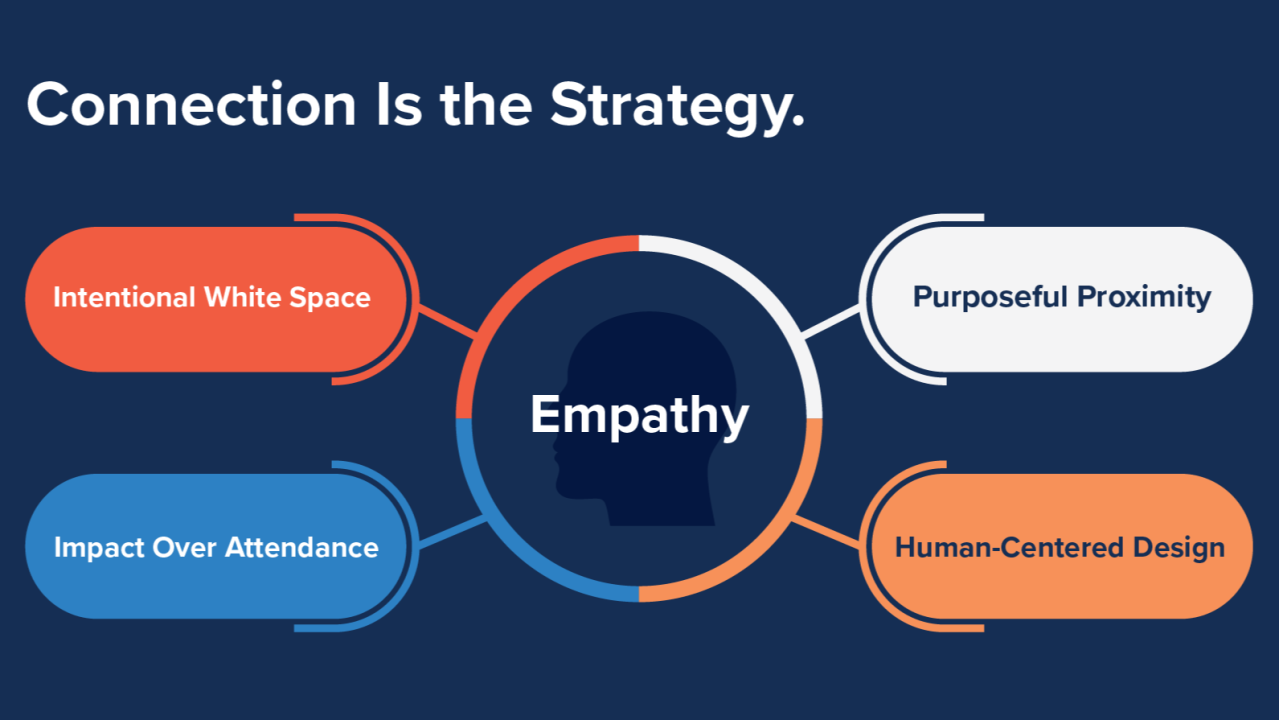
Kim Greene, Director of Meetings and Events at Cencora, shared, “Unscripted time isn’t a threat to achieving objectives. It’s an enabler. When attendees are overwhelmed, they aren’t absorbing keynote messages, engaging in sessions, or connecting with peers. They’re simply trying to keep up. That’s why I treat breaks, white space, and breathing room as part of the event’s core infrastructure, not decorative extras.”
That perspective really resonated with me. If we want people to absorb, reflect, and connect, we have to give them room to do so.
Which leads to the next question: How do we design agendas that prioritize meaningful connection and rest instead of maximizing content? It starts with clarity. Define what you want attendees to walk away with. Once those objectives are clear, everything else becomes more intentional.
Jennifer Phillips, Director of Meetings and Events at Asembia put it this way, “Measuring success isn’t just about how many people showed up; it’s about what happened after they walked out the door. Did they meet someone they plan to stay connected with? Did they leave with a fresh perspective or an idea they can put into action? Are they already talking about coming back next year? Those are the indicators that tell you your event created real value, not just a full schedule.”
That’s the shift: from attendance metrics to impact metrics.
And then there’s networking. For years, networking has been a buzzword in our industry. But recently, it’s taken on a new dimension. It’s no longer a welcome reception that’s also networking, or a 15-minute break labeled as connection time. Brands are being more intentional. They’re asking: How do we make networking actually meaningful?
Susan Benedetti, Associate Director, Global Annual Meeting at DIA, describes it as designing for “Purposeful Proximity,” not mandatory networking:
“We intentionally co-locate high-interest content, lounges, and food and beverage near one another. This encourages organic conversations immediately after sessions, when ideas are fresh, without requiring structured networking events. Attendees engage because they want to, not because they’re told to. We also design topic-aligned spaces. These environments give people a natural conversation starter tied to shared interests, allowing interaction to feel relevant and unforced.”
Purposeful proximity. That phrase says it all.
Finally, let’s talk about showcases, expos, and tradeshows. Oh my!
Large-scale exhibit halls, often spanning thousands and thousands of square feet, can easily contribute to attendee fatigue. When participants are running from booth to booth, squeezing in theater sessions, and walking what feels like miles for a single demonstration, the experience becomes draining. So how do we design expos that energize instead of exhaust?
Delaney Havlik, National Sales Manager at Shepard, shared, “Strategic layout plays a critical role in this experience. The goal is for attendees to get a comprehensive view of the floor without feeling like they’ve spent the day zig-zagging endlessly from one end to the other; a phenomenon not unlike classic Disneyland fatigue. Thoughtful placement of education areas, networking zones, and exhibitor clusters allows movement to feel fluid and intentional rather than exhausting.”
Again, empathy shows up in design decisions that may seem logistical on the surface but are deeply human at their core.
Over the course of my career, I’ve learned many lessons. At the top of the list is this: the difference between a “well-executed” event and a truly transformative one comes down to a single factor. Empathy. When we stop asking, “How much can we fit in?” and start asking, “How will this feel?” we move from producing events to creating experiences. And today, that’s not a differentiator. It’s the expectation.

Cancelled flights. Double-booked schedules. A contagious cold. Too many meetings, not enough space. These are a few of the “worst case scenarios” any event professional is familiar with, haunting every regular check-in with a hint of “But what if…”
Read MoreLike many of my peers, I’ve been known to love a mapped-out process and a clearly articulated task list. Checking off a box brings me joy and getting into a routine of completing my recurring responsibilities is especially satisfying (exhilarating, I know!).
Read MoreAfter leading and facilitating dozens of executive alignment sessions over the years, I've noticed a pattern:
Read More.png)
.png)